
A few days after the local elections, while the King’s Keeper of the Jewels was polishing the Imperial Crown for the State Opening of Parliament, Keir Starmer was holed up in No 10, refusing to meet his cabinet ministers. His chances of survival lurched from hour to hour. Then, on 13 May, the coup against the Prime Minister was paused for a day of monarchical ceremony, while our MPs jostled to receive a glint from the Crown Jewels in order to dignify their manic politicking.
Meanwhile, Tommy Robinson’s followers were booking their coaches down to London and purchasing their six-packs of Special Brew. Pro-Palestine demonstrators were smoothing out their keffiyehs. The Metropolitan Police were readying facial-recognition vans and 4,000 officers to keep the two groups apart.
It was a week of democratic disorder, wrapped in regal pageantry, ending with thousands of radical-right protesters facing off against a mass counter-demonstration. For all its rituals and customs, these are the forces the modern British state cannot tame.
The state of affairs, and the affairs of state, were so dire and unpredictable that the Palace reportedly asked No 10 whether the King’s Speech should still go ahead. The King had just spent three days gladhanding the most sinister acolytes of the Maga movement on his state visit to the US, but he was unsure whether he could observe a centuries-old tradition for his own government. It was a week that epitomised Starmer’s time in office: chaos that he couldn’t control, forces he wouldn’t acknowledge and a clamour for change he did not understand.

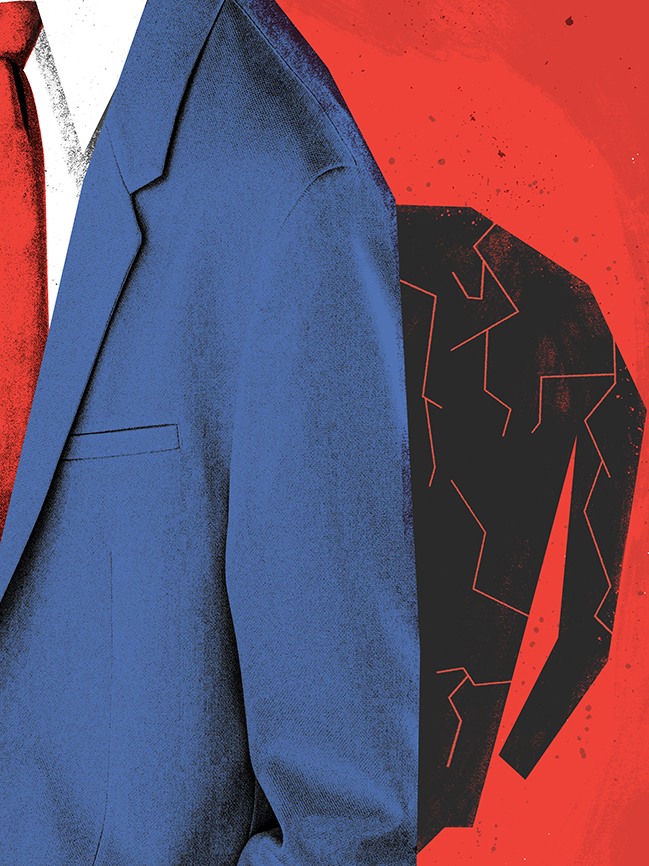
You can sum up Starmer’s failure with a single word: dishonesty. From the start, he has gestured towards something only to turn his back on it at the first hint of opposition. Covering American politics for the past 18 months, I have heard the mocking laughter in Washington DC following each U-turn. It has rung out across the Atlantic, announcing that an empty suit still occupies the highest political office in the UK. The number of U-turns (one count has it at 13) reveals a leader as limp as a sail without wind. More importantly, it shows that Starmer was often dishonest about his beliefs – for surely, if he passionately believed that a certain policy was core to the national renewal he promised, then he would have followed through.
We have a Prime Minister who prides himself on protecting human rights only to trample on our civil liberties, whether those of pensioners tweeting about migrants or students protesting the destruction of Gaza. He seems to believe in every right but free speech. He promised Labour members that he would be the respectable face of Corbynism, only to purge anyone to the left of Clive Lewis. He refused to level with the public about the need for welfare reform: after trying to cut costs, he gave up when his MPs said no – a defeat that effectively robbed him of his majority. He was uninterested in reforming an irrational tax code that suits neither the middle nor working class.
His recent desperate promise to lead the country back into the “heart of Europe” flies in the face of his pledge in the general election campaign to “make Brexit work”. The promise sounds empty because it is: a mirage of easy re-integration without any of the trade-offs. That’s not to say we shouldn’t rejoin the European Union, but the rejoin movement all too easily falls into a kind of nostalgic populism, projecting on to the Continent a utopian alternative that doesn’t exist.
Even Starmer’s laudable opposition to America’s third gulf war was not as laudable as most people think. Starmer was initially supportive of Trump, only for his cabinet to manhandle him into dissent. Speak to British officials and they will say Starmer’s position is purely symbolic: the US and British militaries are working together as seamlessly as ever. Starmer fell into the prudent position out of weakness, and even then, the substance beneath the speeches is continuity. You would think, given the media’s obsession with words not deeds, that American planes aren’t flying sorties from British bases day after day. Was standing up to Trump his Love Actually moment? Yes – in that it was a fiction.
Persuasion through debate is no longer the primary tool of politics. Instead, the government’s instinct is prohibition. Vapes, plastic straws, Palestine Action, tobacco for those born after 2008, far-right activists from Europe, TikTok for children, tweets about immigration. Banning stuff allows the British state to delude itself that it can still effect change through acts of parliament. It signals disaffection with the status quo without having to change anything. Bans do not require the work of institutional reform; they patch up symptoms. It is fingers-in-the-ears government – a whack-a-mole short-termism that Starmer once told the New Statesman was the source of Britain’s woes.
Let’s continue: his proceduralism is apolitical and anti-democratic. Outsourcing decision-making to legal institutions – such as relying on a narrow interpretation of international law to oppose Trump’s war in the Middle East, rather than making the case on moral or political grounds – shuts down justified debate. Whatever these institutions pronounce carries the weight of the rule of law – and you’re not against the rule of law, are you? Starmer does not trust voters. If Tony Blair thought much of government should be outsourced to the private sector, then Starmer thinks politics should be decided in the law courts. Both denude our MPs of agency, removing the incentives for them to engage in debate, therefore stripping the British constitution of its democratic core.
One of the most egregious examples of dishonesty has been on immigration. In a single speech in May 2025, Starmer acknowledged the impact that 20 years of mass migration has had on social cohesion, only to backtrack once his choice of words – “we risk becoming an island of strangers” – was criticised. That didn’t cut it – even on purely democratic grounds. A large section of society has consistently voted for parties that have promised lower immigration since at least 2010, and immigration played a large part in the vote to rupture Britain’s constitutional entanglement with Brussels.
Ironically, under Starmer, immigration will probably fall to its lowest level in decades. But his main concern is about being socially acceptable, not justifying his actions. He has outsourced leadership on a defining issue of our age to his more forthright colleague, the Home Secretary, Shabana Mahmood. Which raises the question again: was Starmer being true to himself when he gave that speech? Or simply doing as instructed? We are relentlessly told, as if this qualifies someone for the office of prime minister, that Starmer is a “decent” man. But doesn’t decency entail honesty?
This dishonesty extends to his top team. Before the election, I often spoke to senior Labour members about the contradiction between their fiscal rules, tax promises and spending commitments. It was obvious that this would lead to gridlock. This was not a basis for national renewal. These are not stupid people. Closed off, arrogant and insecure, they simply did not want to hear the truth. One senior Labour figure admitted to me recently that Rachel Reeves never had any intention of sticking to the promise to invest £28bn in the green economy. It was a cynical ruse, a ploy to keep the left onside, a feint towards a coherent economic argument that did not insist that the only way to be credible was to revere Osbornite relics like Mark Carney and the Office for Budget Responsibility. To her credit, Reeves has increased capital spending, and her fostering of a British AI industry looks promising. But the parameters within which she governs the economy are rote and hackneyed.
Provincial politics is more revealing about the condition of Britain than speeches in the Commons. Reform’s victory in the local election results showed that its meagre number of MPs is not representative of its support throughout the country. This has been true for some time. Large pockets of Britain are increasingly organising themselves along ethnic lines. Robinson’s “Unite the Kingdom” rally was his most Christian nationalist yet – and took aim at the “Islamisation” of Britain. Yet parliament is unwilling to lift its head to see what’s lies before it. Like Xan Lyppiatt, England’s dictator in PD James’s dystopian novel The Children of Men, Starmer presides over it all impassively.
Then there is the media. Those responsible for interpreting politics are steeped in memes. Westminster’s conversation is shaped on X (with a small group of exiles on Bluesky). The Thick of It has burrowed itself into the minds of politicos, instantly putting national decline on the same level as a gaffe. If everything is a meme, then it’s all equally meaningless. Fictional satire serves as a temporary salve to those trying to sublimate the absurdity of reality. Britain’s chronic decline cannot be remedied through memetic irony.
The international right is circling. The defeat of Viktor Orbán in Hungary and Trump’s domestic troubles distract from the fact that structural conditions make populism more appealing than ever to increasingly large numbers of voters. In France, the National Rally’s Jordan Bardella tweeted his congratulations to Nigel Farage for his “resounding success” in the locals.
Farage himself has dropped his brief flirtation with the mundane talking points of the centre right. The Toryisation of Reform was an interlude. Now, he has reverted to visceral populism. Farage already has a Trumpian nickname for the man who might become his most exacting opponent: “open-borders Burnham”.
The next question is whether Starmer’s potential successors have the gumption to be honest. The core tasks are: reckoning with the immigration crisis and brewing ethnic division; reforming a nonsensical tax code; ensuring Britain has a sovereign AI capability; taming the extractive predation of American capital; and rebuilding the military to be ready for action. And yet, it seems as if the Parliamentary Labour Party (PLP) views a candidate’s factional allegiance as a substitute for their views on policy. Unfortunately, “soft left”, “hard left” and “Blairite right” is all poor shorthand for the type of policy debate Labour must have. The PLP should be asking which contender will be honest about the problems we face, not which faction they support. Voters do not care about factional loyalty; they care about what a candidate will do with the enormous power of the office of prime minister – what radical action they will take to revive the collapsing British state. Ideas, leadership and vision matter more than cringe-inducing odes to “Labour values” – a self-defining idea, if ever there was one.
Given all this, the weaknesses and strengths of the competing successors fall into view. Streeting has the conviction to plough through some of the bureaucratic limescale clogging up the British state. In private, he admirably expresses scepticism about the excesses of globalisation. But he is wedded to a Blairite view of politics that is outdated. Angela Rayner has gestured towards some new economic thinking, but the details are sparse and opportunistic. Andy Burnham possesses an aptitude for leadership that is rare in Westminster, a willingness to stand up for a cause, whatever that may be. Burnham will have to admit that Labour has been dishonest to bring together an anti-establishment coalition that Farage has expertly targeted.
This all means calling out Britain’s problems for what they are. Trump’s lies occlude the fact that his rise was fuelled by him talking about issues that animate voters but have long been deemed taboo by the liberal establishment. Farage does the same. Starmer’s successor will have to break out of the cloying managerialism that has trapped the Prime Minister. The question is: who can enact the reforms that those on both the left and right have long known are the only way to bring Britain back from the abyss? Who has the capacity to turn a historic majority into a crusading government?
[Further reading: Cokeheads and Christians: a day at Tommy Robinson’s rally]
Content from our partners



Related

Join the debate
Subscribe here to comment